



Have you ever noticed how a cubby house moves around on an uneven foundation, or watched a swing set lean too far back? That is what makes proper anchoring such an important issue.
Play equipment that is not properly secured is a genuine safety risk, and not just on day one. Ground shifts. Bolts loosen. Australian weather has a way of testing everything you put outside. This guide covers the key standards, soil types, anchoring methods, soft fall requirements and a simple seasonal checklist to help keep things safe year-round.

Why Anchoring Matters More Than You Think
It is tempting to assume a heavy swing set or solid timber cubby will stay put on its own. For a while, it probably will. But here in Australia, we deal with conditions that wear away at that stability faster than most.
UV radiation breaks down materials over time. Clay-rich soils expand when wet and contract when dry, gradually easing anchors from their hold. Sandy coastal soils offer very little grip from the outset. And then there is the wind. Ask any parent in Queensland or WA about unsecured garden gear on stormy afternoons.
The two main risks are tip-over and drift. Tip-over is self-explanatory: a frame that falls while a child is on it. Drift is more gradual but equally dangerous, equipment creeping across the yard over months and ending up too close to fences or hard surfaces. Both are avoidable with the right setup from day one.
Editor’s Tip: “The equipment itself is only half the job. If the ground underneath is wrong or the anchors are not suited to your soil, even a well-built outdoor playset can become a problem over time.”
The Australian Standards You Should Know About
Australia does have standards that relate to playground and domestic play equipment, not just commercial playgrounds. You do not need to become an expert in the documents themselves, but it helps to know the names and what they broadly cover.
| Standard | What it relates to | Helpful link |
|---|---|---|
| AS 4685 series | Playground equipment and surfacing, including development, installation, inspection and maintenance | Standards Australia playground committee |
| AS 4422 | Playground surfacing, including specifications and test methods for impact attenuation | AS 4422 overview |
| AS/NZS 8124.6 | Swings, slides and similar activity toys for indoor and outdoor family domestic use | AS/NZS 8124.6 overview |
You may also find general guidance from organisations such as Kidsafe Australia useful when planning safer backyard play zones.
Reputable brands will often reference compliance or testing in their specifications. If you are unsure whether a particular product suits your yard or installation method, it is always worth asking before you buy.
Know Your Soil First
Your soil type determines which anchoring method will actually hold. Australian backyards vary significantly, and this is one of the most overlooked parts of a safe setup.
| Soil type | What to know | Best anchoring approach |
|---|---|---|
| 🏖️ Sandy soil | Drains quickly but has poor grip, especially in coastal areas | Long auger-style anchors or concrete footings for heavier gear |
| 🧱 Clay soil | Firm when dry but expands and contracts with moisture | Ground stakes or augers can work, but check them regularly |
| 🌱 Loam | Usually the most stable and easiest to work with | Ground stakes and corkscrew anchors are often enough |
| 🪨 Rocky or hard fill | Difficult to drive anchors into properly | Surface-mounted base plates or professional drilling |
Do not force stakes into rock or hard fill and hope for the best. If the ground does not suit the anchor, the anchor is not doing its job.
Anchoring Methods: Which One Do You Need?
Ground Stakes
Most suitable method to anchor lightweight playground structures such as sandpits and small cubby houses. Simply push stakes into the ground and attach them at a diagonal position to the equipment frame. Relatively easy to install and remove but more suitable for loamy soils and clay as compared to sandy soil.
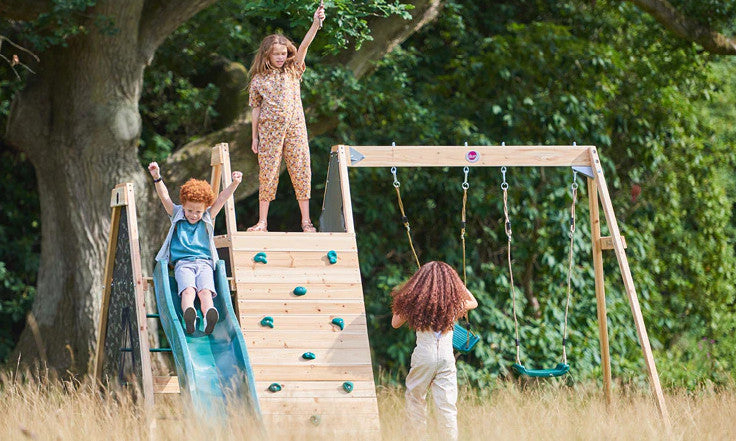
If you are looking at a swing set that uses or suits ground anchoring, the Plum Barbary Wooden Playcentre is the sort of product where checking the supplied anchoring method and soil compatibility really matters.
Corkscrew (Auger-Style) Anchors
Corkscrews anchors screw into the ground instead of being hammered, which makes them offer better holding force as compared to other types. The most appropriate type of anchoring technique for medium-sized swings and climbing frames, especially in sandy soil. More secure option than simply using wooden posts and removable when necessary.
Concrete Footings
Concrete footings are the best choice when dealing with large or permanent structures. Excavate below the active soil layer (usually 400600mm in most Australian climates), set up the legs or anchor bolts, and pour. It's a commitment, but for something like the Kingston Cubby House with 2.2m Slide or the Plum Metal Climbing Dome, it's absolutely worth it. Always check the manufacturer's instructions for recommended footing depth.

Soft Fall: Don’t Skip This Part
The material under the equipment matters just as much as the anchors. Soft fall is what helps reduce injury risk when kids fall, jump or swing wider than expected.
Approved soft fall options commonly include bark chips, loose-fill rubber, coarser grades of sand and engineered rubber tiles. The exact depth needed depends on the free fall height of the equipment and the surface product used, so always check the product details and the relevant surfacing guidance.
| Approximate fall height | Typical minimum soft fall depth |
|---|---|
| Up to 600mm | 100mm |
| Up to 1000mm | 200mm |
| Up to 1500mm | 300mm |
The zone itself should extend well beyond any point where a child may fall, including the full swing arc. If you are setting up a more active play area, such as the Darlington Play Centre, generous soft fall is just as important as the anchor points.
Editor’s Tip: “Soft fall is one of those things parents sometimes treat as optional once the frame is in. It really is not. Anchoring stops movement, but soft fall is what helps protect kids when they do what kids always do, climb, jump and miss their footing.”
Safety Clearance Distances
Anchoring and soft fall work best when the surrounding space is right too. Keep at least 1.5 metres clearance from fences or other structures on all sides, and at least 1.8 metres in the direction of any swing arc. Keep clear of overhead powerlines, and ideally avoid installing equipment too close to hard paving, raised garden beds or retaining walls.
Seasonal Maintenance Checklist
It only takes a quick check at the beginning of every season to stay ahead of most problems.
| When | What to check |
|---|---|
| 🔧 At the start of every season | Check and tighten all bolts, screws and fasteners. Inspect timber for cracking, splitting or splintering. Inspect metal joints and welds. Check that anchor points and footings are still solid. Top up soft fall if it has compacted or thinned out. |
| ☀️ Before summer | Re-oil or re-seal exposed timber that is starting to look dry. |
| 🌧️ After heavy rain or wind | Re-check anchors, especially in clay soils or exposed yards. |
Small issues become bigger ones if left alone. If something looks off, deal with it before the next play session.
Final Thoughts
Anchoring outdoor play equipment properly is one of those jobs that does not feel exciting at the start, but it makes a huge difference over time. A safer base, the right anchors for your soil and enough soft fall underneath all add up to a play area that works better and gives you far more peace of mind. If you have any questions about installation or what suits your specific backyard, email us at hello@thebestbackyard.com.au and one of our team will be happy to help.


Leave a comment